People who visited Istanbul’s Istiklal Caddesi (İstiklal Caddesi) in the new millennium will tell you that it’s a busy but pleasant pedestrian street in the Beyoğlu district, housing a huge variety of shops, galleries, restaurants, bars and cinemas. And that is exact what Istiklal Caddesi today is. However, most people don’t know that it was formerly known as the ‘Grande Rue de Pera’, Istanbul’s most elegant street and home to the city’s smartest shops, various embassies and churches as well as fashionable residences and tea-houses. A street people wouldn’t dream of taking a stroll on wearing an ordinary pair of jeans. Let me take you on a trip down memory lane.
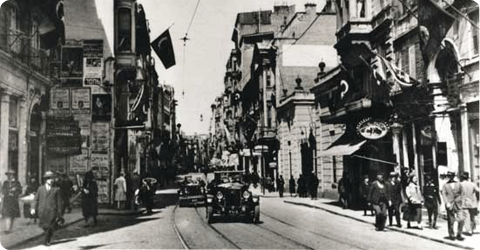
Istiklal Caddesi before the foundation of Turkey
It wasn’t until the founding of the Republic of Turkey that this famous street received its third and present name. Look for  on the Map with Tourist Attractions in the Modern Part of Istanbul. Originally the street was simply called Grand Avenue (Cadde-i Kebir). With the arrival and settlement of non-Muslims and European foreigners in the 17th century, Istiklal Caddesi was referred to as ‘Grand Rue de Pera’.
At the end of the 18th century French, English, Dutch, Greek, Venetian, Spanish, Russian, Swiss and Prussian diplomats built their winter manors in the area. Along with this multi-national population came the still existing variety in religious buildings such as the Roman Catholic churches of Santa Maria and St. Anthony of Padua Cathedral, the Greek Orthodox Haghia Triada, the Armenian Church, and many other churches and synagogues.
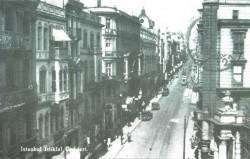 In the second half of the 19th century, due to the development of the transportation and increased foreign trade of the Ottoman Empire, the area between Taksim and Galatasaray improved and became a cosmopolite settlement for the merchants, businessmen, bankers, foreigners and rich people who followed the fashion in Paris. At the end of the century all basic facilities that a modern society requires such as water, gas and the tramway were constructed. Three theatres also simultaneously staged the most famous Paris plays of those times.
Istiklal Caddesi after the Republic of Turkey Was Founded
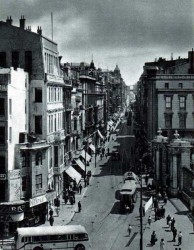 In the 20th century, the connection of the first electrical tramway from Taksim to Şişli made the Taksim-Galatasaray stretch more popular than the Galatasaray-Tünel part.
In the young Republic times Turkish businessmen replaced the foreigners. The Beyoğlu district, and Istiklal Caddesi in particular, became the most modern part of the city. It was the favorite spot of the intellectuals because of the cultural background and variety, together with the presence of renowned restaurants, patisseries, and luxurious shops. The whole street was considered so distinguished that people used to dress up to take a walk or do some shopping in the avenue.
In the 1950s, the influx of immigrants from Turkey’s rural parts to Istanbul caused a sudden, unanticipated growth and rapid urbanization of the city. New formed settlements and changes in the society’s culture made the Beyoğlu district and Istiklal Caddesi lose its crème de la crème profile.
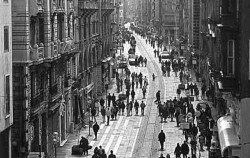 Fortunately, today thanks to an inspired Beyoğlu Beautification Project by the municipality, together with its central location and historical background, the street has regained most of its former status. Istiklal Caddesi is again accepted as the center of the city and packed with people browsing the street with its renovated 19th century Turkish architecture buildings, countless shops and extremely vivid night life. Also see the Istiklal Caddesi photo gallery.
Comments on this entry are closed.